
Casey Handmer, a physicist and engineer, founded Terraform Industries in 2021 with the thesis that increasingly cheap solar energy could soon be used to convert atmospheric carbon dioxide into fuel for less than the cost of fossil fuels. This would enable cheap, carbon-neutral energy for many difficult-to-electrify industries, such as aviation, shipping, and steel, leading to energy abundance and carbon net zero without long-term carbon taxes or green subsidies.
Terraform Industries sells a machine called the Terraformer Mark One which transforms carbon dioxide into methane. This product has received significant attention. However, it is difficult to find concrete information about how it works. This article is an outsider’s attempt to explain how the Terraformer works, its energy and material flows, and the economic and engineering assumptions that will make this venture succeed or fail.
The Process
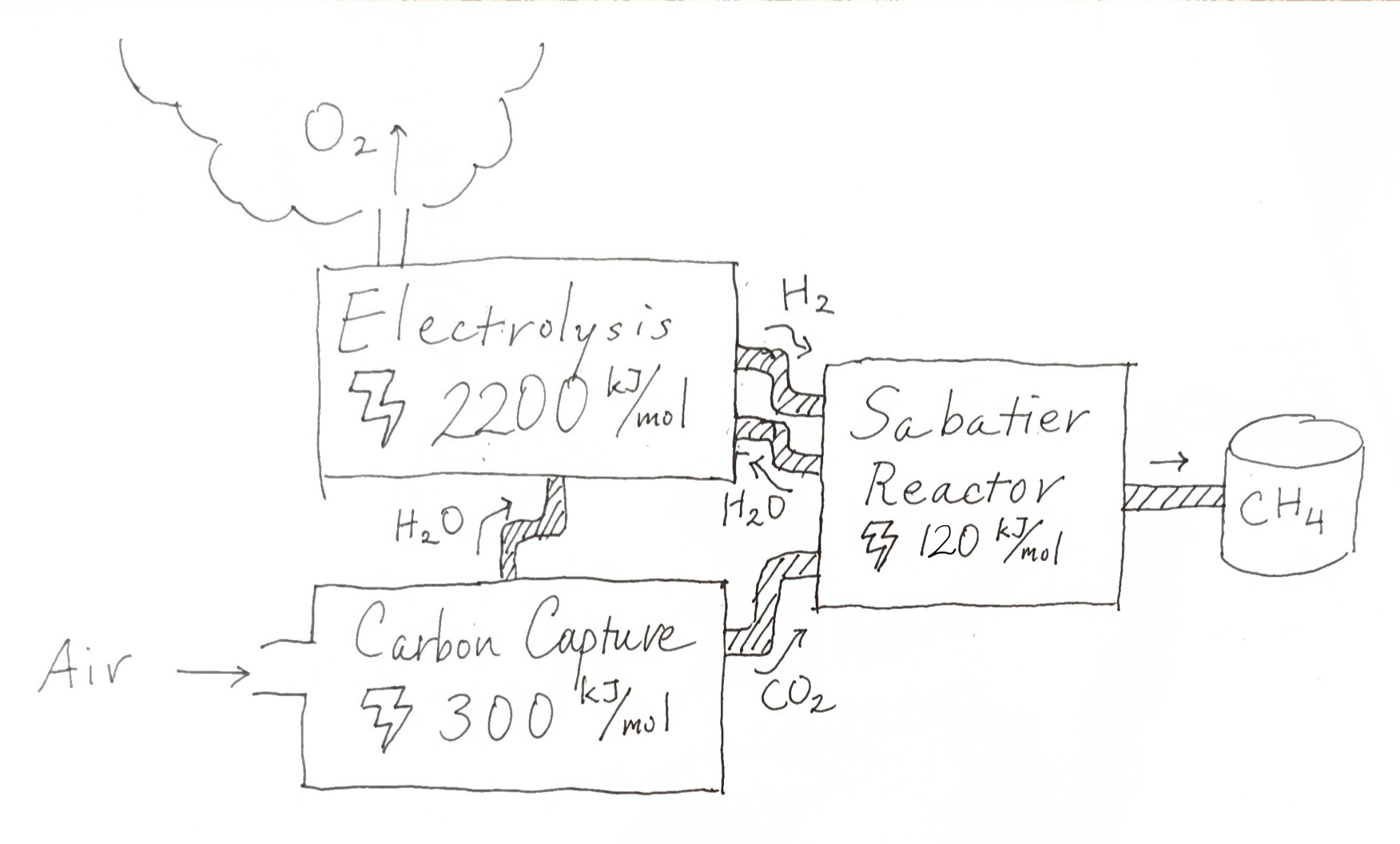
The Terraformer Mark One contains three main subsystems.
The direct air carbon capture system captures carbon dioxide from the atmosphere.
The electrolyzer collects hydrogen gas by splitting water molecules.
The Sabatier reactor combines the carbon dioxide and hydrogen to create the final product, methane, the main component of natural gas.
I will review each step, tracking its electricity requirement per mole of methane (CH4) output.
Carbon dioxide from air
(Many of the concrete details in this section are taken from Terraform employee Akshat Jain’s incredibly useful blog post.)
The first problem we have to solve is: how do we isolate CO2? Despite our best efforts, carbon dioxide is only at 428 ppm in the atmosphere, so capturing it is like finding a needle in a haystack.
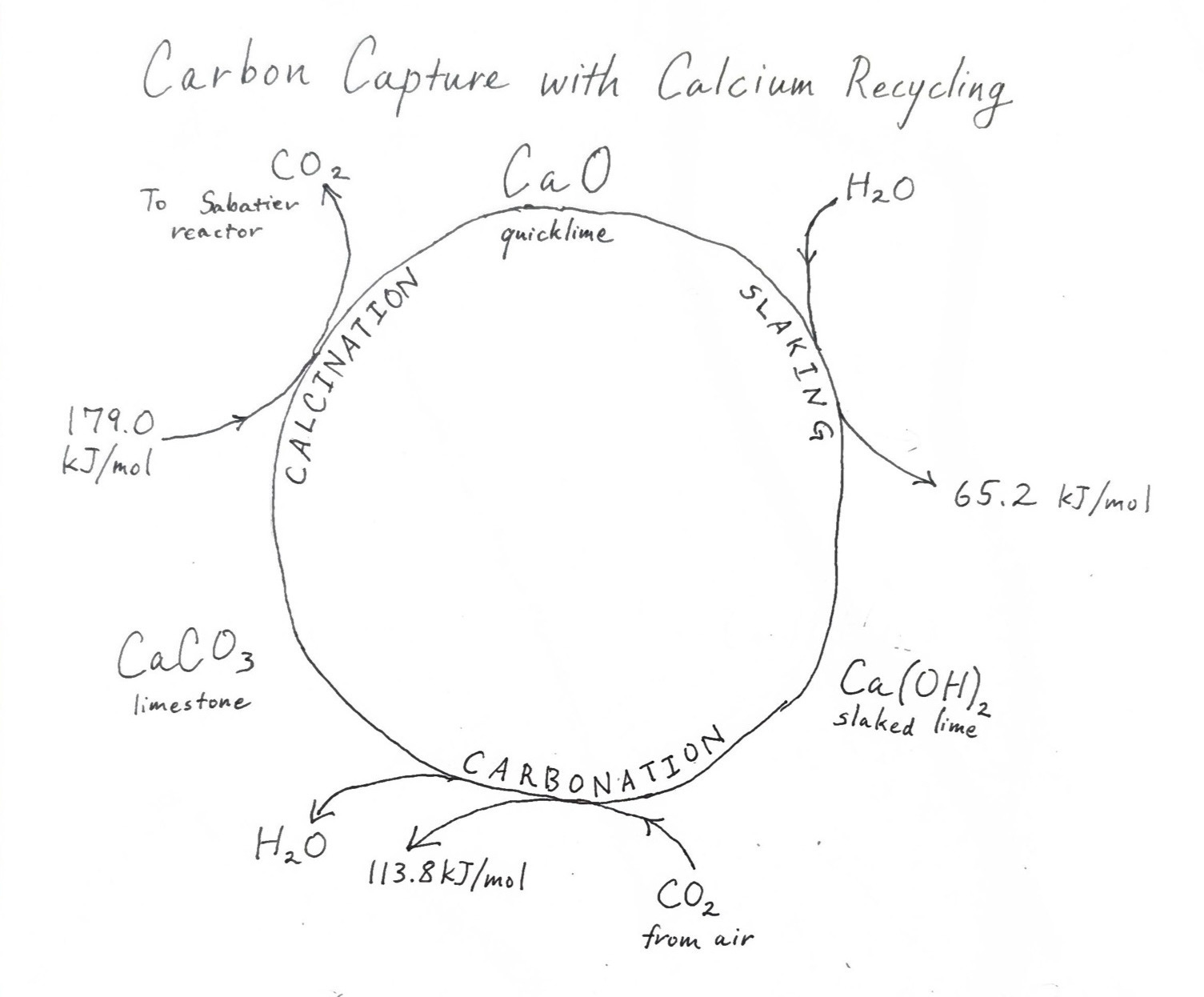
Terraform’s answer is simple: (1) expose air to calcium oxide, which selectively bonds with CO2 to produce limestone; (2) heat up the limestone to purge pure CO2, which is collected, leaving behind the original calcium oxide.
Carbonation
In the first step, calcium oxide (CaO), also known as quicklime, is combined with carbon dioxide from the atmosphere to produce limestone (CaCO3), according to the formula CaO + CO2 → CaCO3. But doing this reaction directly is very slow.
The solution is to add water to the calcium oxide to form slaked lime (Ca(OH)2), following CaO + H2O → Ca(OH)2. This process proceeds quickly and is exothermic, so it releases a lot of heat, 65.2 kJ/mol. Some more water is added to create a slurry, which is then turned into flakes.
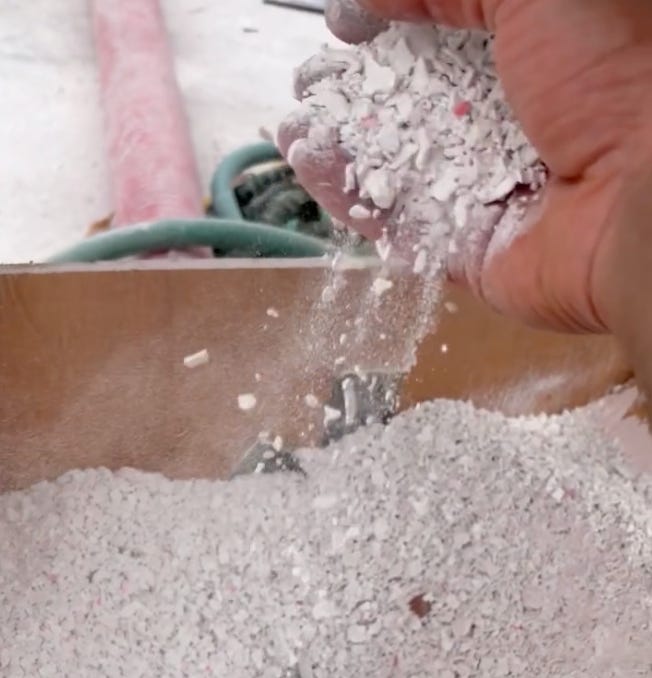
Second, the flakes of slaked lime are exposed to atmospheric air to turn them into limestone. This can be summarized as Ca(OH)2 + CO2 → CaCO3 + H2O. Since CO2 is so dilute in the atmosphere, 5000 liters of air are passed over the flakes every second. The atmospheric water vapor and the residual water in the flakes provides the solvent needed to convert the slaked lime into limestone.1 The other atmospheric gases do not react with the slaked lime.
As this reaction proceeds, the flakes of slaked lime transform into limestone from the outside in, and the CO2 has a harder and harder time accessing the remaining core of slaked lime in each flake. So we move on to the next step before the flakes are 100% limestone.
Both slaking and carbonation are strongly exothermic, producing 65.2 kJ/mol and 109 kJ/mol of heat respectively. This heat may be recycled for the next step, but given the volumes of air moving about, it’s probably just wasted.
The only power requirement is for the fan. At a minimum, unrealistically assuming a 100% extraction rate of CO2, we need to process 61.0 cubic meters of atmospheric gas to get one mole of CO2. Under some more optimistic assumptions, this might take about 7.5 kJ/mol. With a more realistic CO2 extraction rate of 10–50%, plus accounting for the fact that the fans are fast and powerful, the total energy requirement rises to perhaps 20–100 kJ/mol. Let’s take an intermediate value of about 50 kJ/mol-CO2.
Calcination
Extracting the CO2 is much simpler: limestone is heated to directly produce quicklime and CO2, following the formula CaCO3 → CaO + CO2. At 900 degrees Celsius, the CO2 is released from the limestone and is captured, regenerating the quicklime. We get the stream of pure CO2 we wanted, while the quicklime can be recycled for another pass through the cycle.
As the opposite of a process that releases lots of energy, calcination absorbs lots of energy. First of all, it is strongly endothermic, requiring an absolute minimum input of 178 kJ per mole CO2 for the chemical transformation alone. In addition, it only gets going at very high temperatures. Heating it up to the desired temperature of 900 degrees C requires another 74 kJ/mol-CO2.2 In theory, we could use waste heat from either the carbon capture step or the final methane formation step, but the former only gets you up to about 100 degrees C, and the latter seems to add unnecessary complexity. The total required energy for this step is about 250 kJ/mol-CO2.
Combined, the carbonation–calcination cycle takes about 300 kJ/mol-CO2, or at the CO2:CH4 molecular ratio of a 1:1, 300 kJ/mol-CH4.
Electrolysis
While the direct air capture system captures CO2, the electrolysis system is at work producing hydrogen gas (H2), the other important input for the final reaction. Hydrogen gas supplies both the hydrogen atoms and the energy to turn CO2 into methane. But it isn’t just floating around in the atmosphere — we need to get it from water. As we’ll see, this process represents the vast majority of energy use in the Terraformer.
This process is called electrolysis, represented by the equation H2O → H2 + ½O2. The cheapest method is called alkaline water electrolysis. If you force an electric current through water with an electrolyte such as potassium hydroxide (KOH), oxygen gas (O2) will form at one of the electrodes in the liquid, and H2 will form at the other. These electrodes are separated by a membrane to keep the gases separate. Hydroxide ions (OH-) flow through the membrane and free electrons flow through the wire, closing the charge loop. By physically separating the two electrodes, you can get a stream of relatively pure hydrogen.
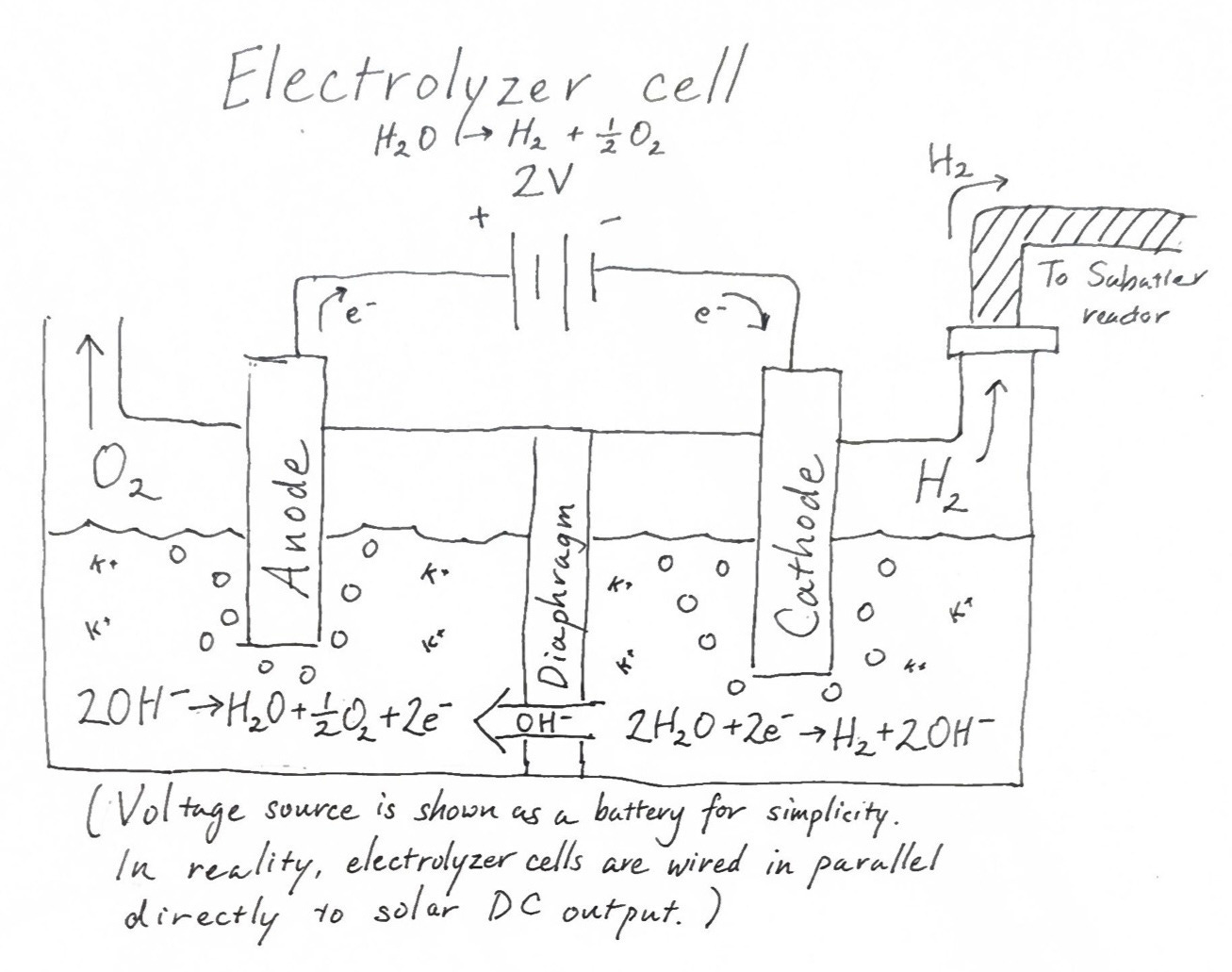
This is how lots of hydrogen is made across the economy, but it’s energy-intensive. At a theoretical minimum, this reaction requires 285.8 kJ/mol of water. Since one mole of water turns into one mole of hydrogen gas (H2), and (as we’ll see in the next section) we need four moles of hydrogen gas per mole of CH4, the theoretical minimum is four times that, or 1143 kJ/mol-CH4.
In practice, even this theoretical minimum is hard to approach. The design space for electrolyzers is enormous—just in the broad category of alkaline water electrolyzers, there is a wide variety of choices for module design, electrode design, and electrolyte choice. These choices all affect energy efficiency, durability, and capex. The Terraformer team prioritizes low capex over energy efficiency, and their electrolyzer is no exception. Terraform claims electrical efficiency of 50%, so we can pencil in something like 2200 kJ/mol-CH4.
The Sabatier reaction (methane creation)
Finally, we combine the carbon dioxide and hydrogen gas from the previous stages to get methane, with water as a byproduct: CO2 + 4H2 ⇌ CH4 + 2H2O. This is called the Sabatier reaction.
The Sabatier reaction takes place entirely in gaseous form in a reactor. Unlike the other two reactions, it is an equilibrium reaction, meaning that its steady state outcome at any given temperature and pressure is less than 100% yield; there will always be some CO2 and H2 remaining. The mixture of CO2 and H2 needs to be heated to about 400 degrees C with a nickel catalyst in order to proceed at any appreciable rate. However, the higher the temperature, the lower the possible yield. Unfortunately, the reaction itself yields lots of heat, which not only worsens the yield, but can destroy your reactor if not controlled!
To deal with these constraints, the Terraformer reactor uses a two-stage reactor with a condenser in between to cool down the gas and remove water. Presumably, this is a single tube lined with catalyst, a cooling mechanism, and more catalyst in that order. Pressures are relatively low, perhaps 2 atm. Terraform claims to have achieved 99.4% methane purity with this setup, which is well within the requirements for pipeline-grade natural gas. Note that although you can sacrifice energy efficiency for lower capex in this stage as well, it doesn’t make sense to sacrifice methane yield for lower capex, because the end result cannot be sold as commodity natural gas if it contains greater than two percent H2 and two percent CO2 by mole fraction.
(By the way, getting those yields in my simulations was not easy. Under a wide range of realistic assumptions, using a setup with two non-cooled reaction stages and one cooling stage and between, I was stuck with purity between 70 to 95 percent. The main problem is that the gas gets very hot during reaction: if not controlled or cooled, it can get up to 1300 K before reaching equilibrium. The maximum long-term operating temperature for 316 stainless steel, a common material for reactors, is about 1100 K, so the reaction must be quenched well short of equilibrium. To achieve high purity, the reaction stages must either be actively cooled or leak a lot of heat.)
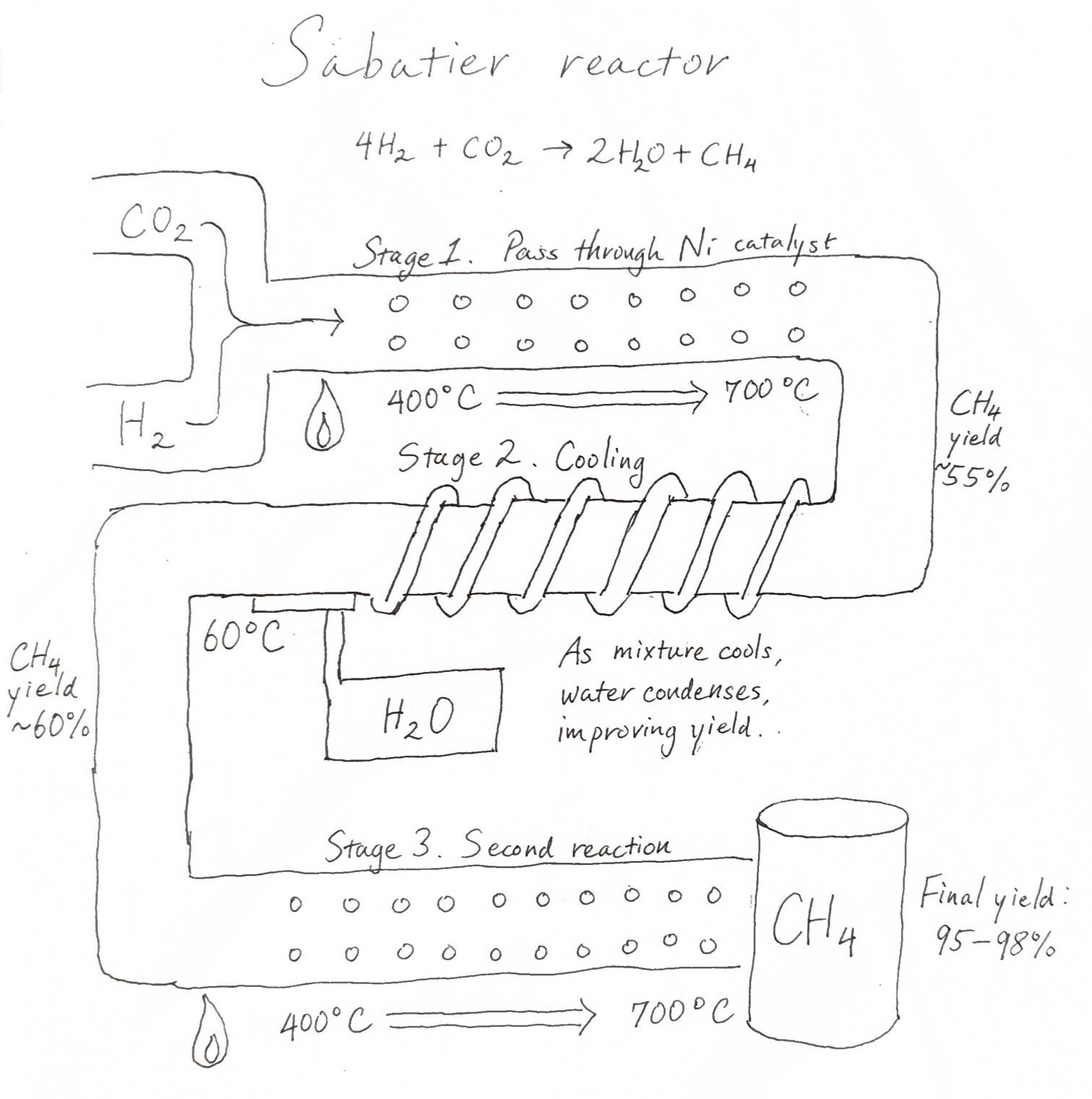
The Sabatier reaction requires 120 kJ/mol-CH4 of electricity. The calculations are in a footnote.3
In summary, to create a single mole of methane, the direct air carbon capture system consumes 300 kJ, the electrolyzer 2200 kJ, and the Sabatier reactor 120 kJ, for a grand total of 2630 kJ/mol-CH4, of which the vast majority is used in electrolysis. Note that, on the one hand, improving the energy efficiency of electrolysis is a big lever if you do want to save energy, and on the other hand, giving up some efficiency in the other stages is not a big deal.
Energy In, Energy Out, Financials
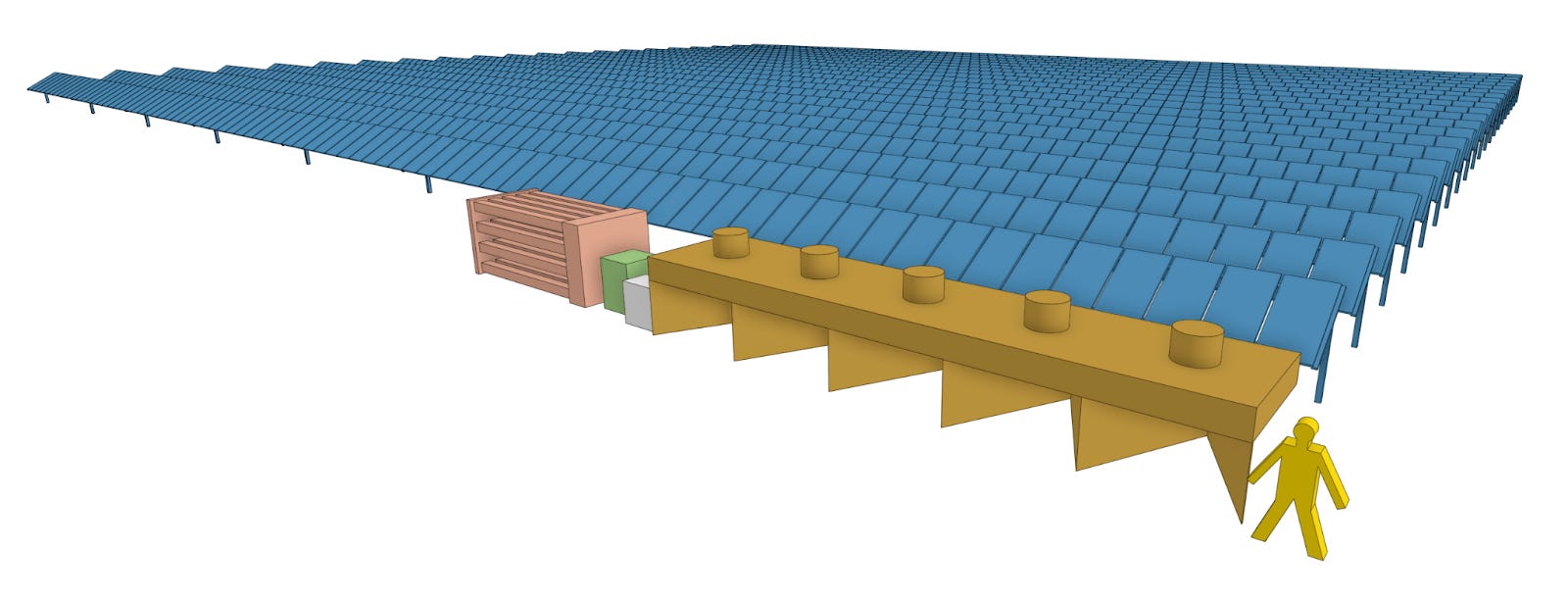
How much methane does the Terraformer Mark One create? It is intended to use the entire output of a 1 MW, 5-acre solar array. Rounding the electricity requirements to 2500 kJ/mol-CH4 for ease of calculation, we can see from dividing 1 MW by 2500 kJ/mol-CH4 that at full power, the system produces 0.4 mol-CH4 or 6.4 grams of methane per second.
At 1184 moles of methane per one million BTU (mmBTU), a Terraformer module running at full capacity 24/7 would produce 29.2 mmBTU per day or 10,600 mmBTU per year. The Henry Hub price, a common price benchmark, hovers around $3 / mmBTU, making this output worth about $30,000 per year. With a realistic 25% capacity factor (long-term average power divided by max power), this drops to 2700 mmBTU or $8,100 per year. This roughly matches Terraform’s own numbers.4
What’s the cost for the operator? The Terraformer Mark One currently sells for $100,000, and they’re targeting a long-term price of $30,000. Much more important is the total cost of the solar array. In 2026, the low end of utility scale PV installations costs $1.10–$1.25/W DC, which comes out to overnight capex of at least $1.1 million for a 1 MW plant. From this we can see two things: first, the Terraformer module itself is less than ten percent of the operator’s total costs. Second, plugging the entire output of your million dollar solar farm into a machine that spits out $8,100 per year is a sub-one-percent return on capital, even before depreciation. In other words, given the current cost of solar, operating a Terraformer is uneconomical if the Terraformer module is free.
Terraform Industries is very aware of this. The most important part of their whitepaper is the section on solar manufacturing:
… Terraform’s growth is already potentially limited by solar PV manufacturing rate. Given a (historically conservative) 30% cost improvement per doubling of PV production, solar PV build out will never be able to catch up with increases in demand as cost improvements unlock new markets, until [net fossil carbon flows drop below 10% of current levels] … Presently, solar PV manufacturing doubles roughly every three years. If this trend continues, there will be as much as a 12 year backlog in demand for solar in markets where natural gas would be cheaper by Terraform’s process, until global demand is saturated some time in the 2040s.”
This also explains their emphasis on keeping the cost of the Terraformer module low rather than energy efficiency. Although most of the cost of running a Terraformer today comes from the solar plant, they expect and need that component to shrink to nothing. That means that the cost of the Terraformer will dominate, while the input energy will be nearly free. If solar prices don’t come down much more, then efficiency becomes more important, but the entire project is doomed anyway.
There is a saving grace for anyone who does want to buy a Terraformer today: the Inflation Reduction Act’s 45V green hydrogen production tax credit provides $3 per kg hydrogen produced. The Terraformer’s annual output of 3.2 million moles of methane creates 13 million moles or 26 tonnes of H2 as an intermediate product, providing a bonus of $77,000 per year. This raises potential revenues to $85,000 a year, which is an important short-term practical concern. However, Terraform Industries is betting that their process will be the cheapest long-term form of natural gas without subsidies, so these should be excluded from an assessment of their approach’s long-term viability.
Conclusion
Terraform’s business is largely a bet on three things, in sharply declining order of importance:
The precipitous declines that we have seen, not just in PV prices, but in total cost of solar will continue to run for fifteen to twenty more years.
In a world of dirt-cheap solar, hydrocarbon fuels will still be in demand.
They can manufacture their machine economically and at scale.
Can the all-in capex for a 1 MW, five-acre solar farm go from $1.2 million to $100,000, as Terraform predicts? I do not know. On the one hand, everyone betting against the long-term learning curve has been wrong so far. On the other hand, as panels become a smaller and smaller portion of the cost, the rest of the cost structure will put a floor below total cost unless those components also become significantly cheaper. In any case, I wish Terraform Industries the best of luck, because a good future for them probably means abundance for us all.
Further questions
I haven’t been able to figure out the answer to these.
How exactly did the team get pipeline-level yields from a two-stage reactor? My guess is active cooling in the back half of each reaction stage, but I’m not sure.
How does direct air capture actually work, mechanically speaking? Akshat’s blog post reads like a description of a batch process with moving parts to shuttle the calcium species back and forth, which would be totally antithetical to Terraform’s ethos of simplicity.
The electrolyzer consumes a decent amount of water. Net of the water recovered from the Sabatier reactor, one mole of methane requires 2 moles of water. This works out to 42.66 liters of water per mmBTU of methane, which again, sells for $3. Where does the water come from? It could possibly be from ambient water vapor already processed during carbon capture, or it could be desalination; Terraform has a job listing up for a Desalination Lead Engineer.
Speaking of job postings, why is Terraform expanding into other chemicals and industrial processes? They have lead engineer postings in ammonia, cement, steel, and aluminum, and they’ve already produced methanol. And what’s the deal with this Secret Projects Lead Engineer job listing? I might write about this next.
To break it down further: water breaks Ca(OH)2 into Ca2+ and 2OH- ions. The hydroxide ions in solution attack the atmospheric CO2, creating carbonate ions and water, according to the formula CO2 + 2OH- → CO32- + H2O. Finally, the calcium and carbonate ions precipitate out into limestone: CO32- + Ca2+ → CaCO3. Some water also remains.
The specific heat of CaCO3 is about 82 J/mol⋅K and we need to heat it from 300 to 1200 K.
Let’s track the energy requirements for each step. We’ll be following a mixture of 1 mol CH4 and 4 mol H2. First, we heat the initial CO2–H2 mixture to about 400 degrees C so the reaction can start. At the relevant temperatures, CO2 and H2 have specific heats of about 44 J/mol⋅K and 29 J/mol⋅K respectively. The thermal mass of this gas is (1 mol-CO2 ⋅ 44 J/mol-CO2⋅K) + (4 mol-H2 ⋅ 29 J/mol-H2⋅K) = 160 J/K, that is, it takes 160 J to raise its temperature C, to 400 degrees C thus requires 160 J/K ⋅ 375 K = 60 kJ. Once the mixture starts reacting, the reaction dramatically self-heats as it progresses toward equilibrium, potentially past a safe operating temperature point for steel if left unchecked.
At the point where it reaches about 1000 K, the condenser stage cools the mixture down aggressively to condense out the water. Suppose that about half the CO2 has turned into methane before entering the condenser. Our initial mixture is now in the form of 0.5 mol CO2, 2 mol H2, 1 mol H2O, and 0.5 mol CO2. Removing 90 percent of the water requires cooling the mixture from 1000 K to about 300 K. H2O and CH4’s specific heats are 35 J/mol⋅K and 46 J/mol⋅K respectively. The thermal mass of this mixture at this point is thus (0.5 mol-CO2 ⋅ 44 J/mol-CO2⋅K) + (2 mol-H2 ⋅ 29 J/mol-H2⋅K) + (1 mol-H2O ⋅ 35 J/mol-H2O⋅K) + (0.5 mol-CH4 ⋅ 46 J/mol-CH4⋅K) = 138 J/K, so it takes 138 J/K ⋅ 700 K = 96,600 J just to get it down to temperature. In addition, condensing water vapor into liquid requires losing 43 kJ/mol; condensing 90 percent of the water in the mixture requires removing 43 kJ/mol ⋅ 0.9 mol = 38.7 kJ of heat. This adds up to 135.3 kJ heat energy lost. Removing 1 J of heat energy requires on the order of 0.1 J electricity, so call the energy input 13.53 kJ. The liquid water is drained away for reuse in electrolysis.
Now we have to reheat the mixture from 300K back up to 700 K so the second reaction stage can begin. It consists of 0.5 mol CO2, 2 mol H2, only 0.1 mol H2O, and 0.5 mol CH4, whose thermal mass is (0.5 mol-CO2 ⋅ 44 J/mol-CO2⋅K) + (2 mol-H2 ⋅ 29 J/mol-H2⋅K) + (0.1 mol-H2O ⋅ 35 J/mol-H2O⋅K) + (46 mol-CH4 ⋅ 0.5 J/mol-CH4⋅K) = 106.5 J/K. Heating back up to 700 K requires 106.5 J/K ⋅ (700 K - 300 K) = 42.6 kJ.
If we round final purity to 100 percent, the three stages require 60.0 + 13.53 + 42.6 kJ/mol-CH4 which rounds up to 120 kJ/mol-CH4.
The whitepaper v2 projects much higher revenues of $24,500 per year, based on a gas price of about $10/mmBTU. Handmer was writing shortly after the first summer of the Russia–Ukraine war, which was the only time in the last fifteen years when prices have been anywhere near that high. Unjustifiably in my view, he projected that these prices would persist into the near and far future. Anyway, $24,500 annual return on a million-dollar-plus investment is still not a great return on its own.
A note on the chemicals focus—industrial processes for cement and steel are among the principal drivers of carbon emissions and fossil fuel use. Many of these chemicals depend on methane as a feedstock, and they also require immense heat that is often driven by fossil power.
great analysis! love the hand-drawn diagrams